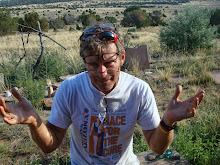
Mesquite and palo verde trees are blooming, and the semester is winding down even as the days heat up. It will be in the 90s today, pushing a hundred later next week. Full blown spring with a taste of summer.
As the days go by, I wonder what I will do with this summer. I always hope that I will write something over the summer, maybe even publish something.
Instead, I have written vignettes that turned into blogs that a few people read, but don't really care about and would not pay for.
So, why do I do this? What's my story about writing? I am trying to figure out what I have to say, what I think, what the thread is running through the chaos of my life, for starters.
I am also trying to shape, or form, who it is that resides beneath the waters of my unexamined psyche. I write to blow off steam too. I write to rant. I should be nice to my bride, but I am not. She is not so happy with me and I am not so happy with all the things she wants to do with my time. I keep running away.
Summer makes it worse. It's hot and tiring. I do manual labor because we are not satisfied with what we have. We are building a house and planning to live in another place. One home, one place, is not enough. Always moving, always hungry.
Will I finally wake up and begin to focus on the short time I have left on this earth? Or will I continue to act as if I will live forever and continue to put things off "until I have time?"
The "I'll get to it later" way of thinking has resulted in piles upon piles of stuff in my home and office. I am a hoarder of bike wheels, jackets, and bike shoes. I have too many socks. Too many loose ends.
That's the way it is. I need to look straight at it in the hot, clear light of summer. I hope the heat will burn off some of the fat in my thinking, my fat habits. We'll see how it goes.
Friday, April 5, 2013

Friday, March 8, 2013
The Tipping Point
Seems like the whole world's walking pretty and you can't find no room to move. -- Bruce Springsteen, "Tenth Avenue Freezeout"
The changes are incremental at first: a lost word here, an unpaid bill there, a forgotten birthday card. But they add up, and pretty soon, the world is moving too fast. It pulls away, slowly, but steadily. Pretty soon it has rounded the bend ahead and you are left plugging along on your own.
Each word, forgotten appointment, missed commitment leaves a vacuum, an empty space, where once you know there was "something." The brain scrambles to place the missing puzzle piece back into place, searches in vain for the word.
If you are not supposed to be right up there with the hustle and bustle, there is not much of a problem. You coast along and eventually pull off and take a long nap under the trees that line the road.
That is the luxury afforded to the affluent, those ready and able to retire.
But you are supposed to be right there with the group, on top of the latest initiative, plan, problem, report, appointment, decision. That's when things get dicey, when you feel shame.
You feel like you have to keep up if you want to have health insurance, pay the rent, keep the car running. Pulling off into the trees is not an option and you push yourself harder to keep up.
For a few years you can do it. You close the gap and the rest of the group believes that you are there with them, willing and able to sustain the pace, eat up the tasks of midlife -- house-holding, productive contribution. But those efforts become harder and you can't continue that level of output. The pace is just too fast for your heart, lungs, legs. You vision shrinks to a tunnel. You see the world through a tube that becomes longer and longer, limiting your field of vision.
What happens then? Those up ahead forget you and move on, consumed by their own problems and pushing hard enough to hang or maybe even pull ahead.
You are left with a memory of what it was like. But even that fades as the will to go on withers like falling leaf.
At some point you are asked to surrender. Your income, insurance, car keys, friends, faculties, are all confiscated. If you are lucky, you get left alone.
Then it begins not to matter so much, except when a cadre of cells detects the pheromones of hope or desire.
Such is the insult that is called growing old. But an insult only works when one is still attached to the illusion of an identity that has to be defended. Aging has a way of ripping away strength and the hope that I might still win.
In Western culture, where personal worth derives from achievement and image, the decline of faculties can lead to despair. We see ourselves as our work, our wealth, our looks, our abilities. Even some "spiritual teachers" conflate the soul with wealth and social standing. (Those teachers, by the way, tend to charge exorbitant rates for their wisdom; they tend to live luxuriously and work only with the well-to-do.) The arts, though, if they are good, see past the ethos of the bottom line, the Performance Principle. Eastern thought even gives us multiple chances to get it right. You're working for a different master.
Recently, I was overtaken by a surprising surge of energy that one could only call love, a fierce, unrequited love, and I had no defense against it. Some fine writers have reported back to us readers that such experiences signal their descent into the swirling waters of surrender, annihilation of the self, a live wire of intensified poignancy. Rumi writes "there are no edges to my loving now." and Gabriel Garcia Marquez says, "The truth was that I could not manage my soul, and I was becoming aware of old age because of my weakness in the face of love." Ruben Dario writes "When I want to cry, I can't/but I cry without wanting to."
The controlled self, whatever that is, falls away, and joins something bigger, more universal. It seems that what looks like decline in aging may be an opportunity for entry. Falling behind is not necessarily the end, but rather passage through a portal. A lifetime of keeping up may be prologue. One's heart, or soul, or better self, a spiritual presence, or whatever you want to call it can begin to guide you.
As the racers fade around the bend, what seemed disaster may become blessing. The light burns most intensely when it consumes the ephemeral.
Saturday, March 2, 2013
Mecury is in Retrograde -- Rejoice!
"Whatever that means," I think to myself when my friend and spiritual advisor, Constancia, delivers the astrological bad news.
"Things are going to break and go wrong for the next couple of weeks," she adds, "so be careful."
When I stop to think about it, I realize she may be right. Mine and others more than fair share of things going wrong seems to have grown larger in the last few days.
A sleeping man is swallowed by the earth beneath his bed; law makers think it's a good idea to throw Head Start kids onto the streets; my computer crashes; friend, neighbor, and kindred spirit Philip decides to move to England; my son hits a parked car; the buckle on my bike shoe breaks mid-ride.
While evidence of the world going to hell in a hand basket is both my default way of seeing things and never in short supply, I opt to widen my view. My remaining cat (the other was taken by a coyote) loves me (though not as much as she loves Kyle). I still have enough cold, hard coins to obtain a burrito (bean) between classes. I have wonderful friends who delight in making fun of me. The list is pretty long if I work at stretching it.
Yes, I am not in a position to join my affluent brethren on their ski trips to Durango or yoga sessions in Bali, but I can jump in my truck and drive to Eloy, thirty miles up the road, home of The Whopper.
Life is good. In the state of grace and gratitude, rather than envy and grasping, I hope to loosen my grip on all I think I control or possess.
And Mercury is helping me along in my lessons on letting go of even the modest gifts the universe has given me. At 56, it is time to practice detachment, I am told. Things, The Body, Relationships -- All -- will soon be history. The only logical response is to surrender, no, embrace, the decline and loss.
In the spirit of that old Mercurial messenger of wrack and ruin himself, George W. Bush, I say "Bring it on," just in little ways, por favor.
"Things are going to break and go wrong for the next couple of weeks," she adds, "so be careful."
When I stop to think about it, I realize she may be right. Mine and others more than fair share of things going wrong seems to have grown larger in the last few days.
A sleeping man is swallowed by the earth beneath his bed; law makers think it's a good idea to throw Head Start kids onto the streets; my computer crashes; friend, neighbor, and kindred spirit Philip decides to move to England; my son hits a parked car; the buckle on my bike shoe breaks mid-ride.
While evidence of the world going to hell in a hand basket is both my default way of seeing things and never in short supply, I opt to widen my view. My remaining cat (the other was taken by a coyote) loves me (though not as much as she loves Kyle). I still have enough cold, hard coins to obtain a burrito (bean) between classes. I have wonderful friends who delight in making fun of me. The list is pretty long if I work at stretching it.
Yes, I am not in a position to join my affluent brethren on their ski trips to Durango or yoga sessions in Bali, but I can jump in my truck and drive to Eloy, thirty miles up the road, home of The Whopper.
Life is good. In the state of grace and gratitude, rather than envy and grasping, I hope to loosen my grip on all I think I control or possess.
And Mercury is helping me along in my lessons on letting go of even the modest gifts the universe has given me. At 56, it is time to practice detachment, I am told. Things, The Body, Relationships -- All -- will soon be history. The only logical response is to surrender, no, embrace, the decline and loss.
In the spirit of that old Mercurial messenger of wrack and ruin himself, George W. Bush, I say "Bring it on," just in little ways, por favor.
Wednesday, February 13, 2013
Life Underground (A Meditorial -- Meditation/Editorial)
Life is different on the other side of the electric gates, fences, dogs, and concertina wire. Time passes like thick syrup; a pervasive sameness pervades the days; and the yards are crowded. There are many more men than the writing workshops can accommodate, and, sometimes, the number of men who show up make them unwieldy and chaotic. We don't have the chairs, tables, materials, or time to hear from everyone. Men get frustrated. They walk out.
I can't claim to know anything beyond the vaguest notions of what life is like outside the workshops on the yards and in the cells. I am not subject to dehumanizing treatment, the brutality, abuse, rape, or politics of predation and power. But I do see that there are more poor, more black/brown/red, more illiterate, and more mentally ill men in prison than I see in random scenes in Tucson. Prison seems a kind of holding bin for both the criminal and the outcast. And the numbers, by my count, are excessive.
If we counted up all of the people currently under "correctional supervision" in the United States and made them a city, they would be the second largest city in the country. In other words there are more than six million inhabitants in our prison system. We are the world leader in locking people up. Of the people we lock up, too many are non-violent, poor, black, and addicted.
Prisons are also big business. More and more are privately run organizations with powerful lobbyists who buy state politicians. We are "bankrupting our states and creating a vast underclass of prisoners who will never be equipped for productive lives," according to Fareed Zacharia.
The cost for this underground society is one we pay for by cutting education and other social programs. Funding for schools goes down while funding for prisons goes up. Already poor schools in tough neighborhoods get less. More students fall behind and find ways other than school to get recognition, worth, community. Crimes, gangs, homelessness, addiction add up to a cycle that digs deeper into an already underground existence.
These men and women serve as fodder for a hungry prison business that needs more and more people to sustain growth and keep investors happy. We exploit misery.
In spite of this, most of the men I encounter are bright and want to learn. They come to the workshops a little sheepish until they find their footing, their voices, and some trust in the truth of their experience. Many in the hopeless and stagnant world that prison can be find 12-step programs, some form of spirituality, or reading and writing. The thread they hang onto is so thin and subtle as to be all but invisible.
It is a thread many of them follow in the dark, the subterrainian darkness that is out of sight, hidden in shadow, as dangerous as it out of mind.
Thursday, February 7, 2013
To Catch a Thief
I've often had fantasies of what I might do if I caught someone riding one of the seven or so bikes I've had stolen since I moved to Tucson.
Yes, I can hear what you might be thinking -- Since you moved to Tucson?? that was like, what, thirty years ago?? And you would be correct in advising me to move on, to forget, let go, and live a life free of trying to recoup my losses.
But I can't seem to help it. I am a bike-ophile, a bike-aholic, an obsessed bike geek-materialist-Americonsumo-cum-laude. I can tell you the make, model, size, color, and components down to the level of minutiae ad absurdum ridiculo of every bike that has been filched, jacked, kyped, pinched, or swiped. That blue Cannondale M-800, for instance, the one that walked out of my back yard in 1998, had White Industries hubs with Velo City rims laced with red alloy nipples and blah be da blah blah. My list of wrongs done to me is long, and my monkey mind can't seem to get off it.
So, two bikes were recently lifted from my front porch. One of them was a Bianchi S.A.S.S., which stands for Shiny-Assed Single-Speed. While still in the throes of grief and violation, I was driving down our fine Fort Lowell Road when I passed a Circle K and saw SASS being piloted along the sidewalk. I knew it immediately; in the time it takes to snap a photo, I saw the the carbon seat post, the Monkey Lite bars, the Avid disc brakes, the gleaming chrome frame.

"My Bike!!" I yelled out the window at a stunned 20-something guy. He jerked his head, and we entered a fast motion comedy of drama and errors.
He crossed the road and I swung a U-turn with no thought of traffic (not recommended), and pulled into a gas station to head him off.
You could say I went bonkers, berserk, ballistic. All of the injustices of life funneled and fused into one white-hot nerve of indignation and righteous rage. I was living the fantasy, the dream of redemption of all that has been lost, the final turn into Ithaca after long years of battling the Cyclops, sirens, and privation. This was IT, the moment.
"Hey! That's my bike," I yelled as the car stalled. It was blocking the driveway to a gas station and the door hung open as I strode up to the startled young man now standing next to the bike. He could see I was shaking, was hopped up on adrenaline, had the blazing eyes of the insane.
"Uh, uh, I bought it off of Craigslist," he said, not so confidently.
I had been monitoring CL for the past week and had seen nothing of the missing bikes, so felt fine challenging this claim. I approached it logically, with all the cool, calculated method of a prosecutor moving in for the kill.
"Bulls%$t!!!" I sputtered, foam forming around the edges of my mouth.
Nothing.
"Bulls*&t!!!" I said again, even louder and crazier than the first time.
I stepped forward and began poking at his chest with my bayonet of a finger.
Now, the youngster started to wilt, to back down. He released the bike. He put up his arms as if to say, "Whatever..." and backed away.
It then dawned on me that it might be a good idea to call the police, so I pulled out my phone with my free hand and dialed 9-1-1.
I noticed he had turned and was walking briskly down the street. He was getting away. I had the phone in one hand, the bike in the other, the car stalled in the entrance to a gas station, its door still open, the keys still in the ignition, lights still on.
The words were out of my mouth before I could think."I'll get you, you a**hole. You and your family too. All of your children, ancestors, and distant relations. I'll find you and yours and ... I'll...I'll...." I'll what?
"Hello. What is the nature of your emergency?"
As I spoke with the operator, I came down from my adrenaline rush.
The whole scene became ridiculous and unseemly. I was standing there with the bike, wearing my teacher nerd pants and button-down shirt watching a young guy run followed by a mob of ghosts -- angry, wounded, hungry ghosts.
Monday, January 28, 2013
The Signature Move
The road to the prison is a long one, and you will want to turn around before you drive past the melting tar, hot-engine smell of the power plant. You will think briefly of all the other things you might do today -- go for a hike, work in the garden, watch the basketball game -- but you will settle in to the sound of the car as you merge onto the interstate, doing what you need to do.
You will look into the mirror and see the face of an old man, the bags and sag of the face you thought you would never have. You will feel tired, maybe sick, all of a sudden as you make the turn south. Do not go numb when you see the towers of the federal penitentiary off to the right. Do not hope that the guards will be waiting at the entrance behind a barricade that says no admittance. You may cringe when they say "I'd like to kill all of them," because they are frustrated and afraid and impatient. Do not smile when they call the men in your workshop cockroaches, rats, or worse.
You may tell yourself that you are not up to this, not bright enough, not ready, nor skilled enough, that you have no business asking men in a cage to hone their expressive skills. You certainly will not feel driven by some principle of fairness or service. You may remember something from years ago, a time when a man with a badge read charges against you, that he said you were going to jail. You might also remember the pucker of your nether regions as you think of the pills and weed hidden in the pockets of your girlfriend's purse, that because she was the daughter of The Man, and had a stack of traveler's checks, that they did not search her the way they did you. You will remember shame and gratitude, the feel of your car keys, your wallet, your watch, as you carried it all out of the courthouse back into a morning bright and clear with mountain sun. You may or may not remember that you wished someone would tell this if you went down.
You will have to smile instead of argue when they ask why inmates need paper, pens, dictionaries and books. You may have to lie when they ask if you plan to leave any of this with them so they can take it back to their cells where they will settle back onto their racks and think about what to say and how to say it.
As you carry the tubs you will look away from the blood spots on the sidewalk that go on for thirty yards and will not wonder what could have happened here. The tattoos on the neck of a member of the AB, the Aryan Brotherhood, will not scare you, even when he challenges you on why you think his friend's poem is overly cliched and sentimental and full of racist jargon.
If you forget that it is you who are the lucky one, that you might be confined here, then you will be lost. You have the comforts that you only dreamed of when you stood on the side of a road, with no money, in the cold. Or the time your boss reminded you that you were on the clock, so do that damned job over again, even if it's already done and done right.
The live wire of memory may be too much, so you will push it away. Try pain killers, but they will not silence for long the whispers, even when those voices are smothered in the cotton of comforts. You may want someone to do the work for you or someone to take care of you, but you know that it is up to you.
But still, you pack up the books and papers when the time is up. You cover the sore with a bandage and go back out into the noise of the free world.
Eat. Go back to sleep. That is the way to keep going, to get by, to take shelter from the wind.
Wednesday, January 9, 2013
Eating My Words
Megan and I are driving south of Tucson to the little burg of Patagonia to help some friends work on an old ranch house. It is New Year's Eve, so traffic enforcement on the winding highway climbing up to Sonoita has been beefed up. State Patrol cruisers parked conspicuously on fast, straight stretches of highway look dark, menacing.
The old truck makes deep moaning sounds at speed, so I keep it under 60. I am not worried about drawing attention.
We talk the way couples talk, lapsing into subtle irritations and criticism just because we have to vent a bit once in a while. Megan reminds me how hard it seems for me to let go of things -- shoes, T-shirts, youth, vigor, hair, height -- little things. I politely listen in silence, building up a litany of rebuttal that will soon be delivered, once I can get a word in.
The lovely tawny hills of Sonoita spread out like a blanket from the foot of Mount Wrightson. It is winter and the sky is cold and bright. Snow fills the shadowy defiles cut into the rocky heights. It is movie backdrop, a scene fit for real drama.
"You know, a bunch of people have gotten speeding tickets lately near Patagonia," Megan advises. She mentions friends and family, scofflaws who ought to know better, who have been cited. All the locals have talked their way out of, even when drunk with no registration or insurance papers. She says there's a wing-nut cop who is obsessed with giving city folks tickets, a spit-and-polish ex-marine. "Even the gas station guys don't like him," she adds. Between the lines of her counsel is the implication that I am not so lucky -- or charming -- as our friends who gotten out of big fines.
This is particularly irritating because I rank below the local malcontent reactionaries. The gas station guys pride themselves on being PIGS, the "Politically Incorrect Gas Station.," and tend side with law and order while opposing "bra-burners" and "tree-huggers."
I have to sit with that for a bit. I have a spotless record (except for the one time near Duncan, AZ that I do not like to remember and tend to omit whenever the subject comes up) for traffic tickets. Everyone in my family has had a ticket, but for more than 15 years I have been ticket free, in spite of my tendency to drive faster than I should. I feel I can drive how I want, even through speed traps.
The writer in me takes over and composes a dialogue fit for the occasion.
"I don't get tickets," I say.
That is a good start, I think to myself, but is not quite enough. It needs some elaboration.
"I am special."
Ah, yes, that is good too. But special in what way?
"In fact I have a sixth sense about when to speed. I can tell when there is going to be a cop with a radar gun."
The hole has been dug.
As these words are leaving my mouth, we enter the town of Patagonia's way reduced speed limit, and I slow a bit, but not enough.
True to script, the sheriff is parked in his truck with the gun on. Right on cue he pulls out behind me. Within seconds I am below the speed limit and I am sure it is just a coincidence. We drive s-l-o-w-l-y into town, and I make the turn toward Harshaw Canyon and the ranch house. He turns too. The lights come on.
Megan grins a big grin. I sink into my seat.
So, I will be spending this coming Saturday at traffic school with the other scofflaws. We will all be eating a piece of humble pie, hoping to return soon to the promised land of exception from the laws of man and spirit. After all, we are so very special.
Megan will not let me forget.
Subscribe to:
Posts (Atom)