Monday, October 21, 2013
She Reassured Him
They went to the wedding as a favor to the bride. Neither knew her well, but there would be food, maybe some laughs. It had gone nicely so far, better than expected, and the evening surprised them with its rare loveliness.
The night offered itself up like an answer to secret hope, with the selflessness of a new lover. Tiny stars on electric wire wound their way up trees in the courtyard as the sun set behind a crimson horizon. A deep blue followed the receding reds and pinks, and as the sky darkened, the moon peeked over a mountain ridge to the east. It was all linked together, all in motion on an October night in Tucson. The heat of the day radiated up and out into the cold, violet indifference of space. Fernanda borrowed Jason's sport coat to fend off the first chill of darkness.
Music played. She wanted to dance. And Jason had some really good weed, so good that she knew they would go home after the reception, fall into bed and find each other under covers as the train passed through the downtown, blaring its deafening warning.
But now, they sat at the banquet table with strangers. She drew the eyes of men, she being the perfect mix of young, fresh, smooth, and cool womanhood. Pheromones wafted off of her. I heard a falcon shriek from his perch on one of the downtown skyscrapers. Her eyes sparkled with the same, clear sharpness of the Christmas lights winding up the trunks and branches of the trees. There was glitter mixed with her eye shadow. She radiated an openness braided with mystery and exotic blossoms. She spoke with the slightest of accents, was from deep in Mexico a long time ago. But now she was above the rough status of immigrant, having climbed up the educational barrier into professional income and easy American sophistication. She was fluent in the moves.
Jason looked a little worried when one of the men looked closely at her and spoke to her with an intimacy that took Fernanda by surprise. She warmed to the stranger as if by reflex.
Jason straightened up, taking more notice of the conversation. He needed her to want to be with him. There was so much undone in his life, and her attention helped him to forget, or at least to tolerate the nagging need to get his act together. He found comfort in her, craved her like an addict craves a fix. She could break him with a tilt of her head. So much was at stake. He did not want to be alone with hard facts.
Fernanda saw this, or sensed it. She took her hand from the table and reached for his leg. She ran her smooth, small, strong hands along his thigh, in full view of others.
She was his, her hand said, and Jason fell back then, into a relaxed posture, now resting against the stiff back of the chair.
She would wear his jacket, go with him to the quiet place where they could share a joint, watch the sun's warm colors give way to night, and then look for that peace where sleep comes without fear.

Thursday, October 17, 2013
To Really See a Thing
You have to stare.
You have to stare so long that all the thoughts and feelings and associations run their course, get bored, and run off to lives on the coast.
Then, when all that chatter dies down, you might be lucky enough to see the thing as it is.
As it is in all the miracle of its form at this moment.
Even a humble chunk of gravel, the modest aggregate of granite, or quartzite, or garnet, is in motion, in transit, an ongoing event.
The zebra-tail and desert spiny lizard share this pulsing ephemerality.
How did all those atoms come together to make this shape, color, texture, and ongoing event of this thing as it is?
If you begin to know the answer to this question, you are likely old enough to see that you too are a moving mass of energy, that most likely is in some form of decline. Your heart knows that what you call "me" is shutting down, slowly, and that this particular expression and arrangement of form is in transition.
Then part of you will know the loss and perhaps be afraid.
But you cannot lose something that you truly know, and you cannot truly know without grieving the loss of what is, and loss becomes joy as you witness what is becoming. Joy and grief trade places.
Joy and grief allow you to really see the thing, but are not a substitute for knowing the thing. That comes later when there is no longer any difference between the two.
Then there is no Other. You are the thing you see, the thing you seek.
Wednesday, October 16, 2013
Invisible Courage
Students in passing periods at the University of Arizona clog the hallways of the Memorial Union. Walkers, mainly students in the blossom of beauty and youth, move like blood cells through crowded veins. Most of them carry an air of confidence, are simmering in age-appropriate narcissistic self-assurance, and they dress to the nines, with looks right out of fashion magazines.
Yesterday I came face-to-face with a young man who did not fit the mold. His features were exceedingly deformed, the cranial symmetry distorted in a shocking misplacement of of eye sockets, cheek, nose off to the side, and mouth that turned down on the left side. The condition looked genetic, not trauma caused.
And he was not dressed up in the hottest hipster gear.
I had to collect myself so I didn't stare, or worse, wrinkle my face in fright.
This young man passed through the flowing river of students with the same air of purpose and direction as the rest. I had to wonder how he had acquired such courage.
And the amount of courage it must take to get up day after day and enter the beauty parade of a place like the UA, must be up there with the great heroes of history. And, yet, he likely received little, in any fanfare or recognition for this heroism beyond a devoted family or long-term friends.
If he were a veteran, returned from Iraq or Afghanistan, he likely would have been lauded for his courage. Fighting a country's wars, or doing the bidding of the ruling class usually wins a pat on the back and some public acclaim.
But recognition of heroism is not evenly or fairly distributed. A personal battle to get up and face a world that never stops staring at you does not necessarily register on the radar of Good Morning America.
If there were a way to measure courage, to measure the degree to which a person has to marshal the will to move in spite of inertia to stay out of aversion, would we allocate recognition where recognition was deserved?
Maybe, but that is not the way it is right now. Heroic acts that strengthen the existing structures of power are the ones that get the press. Playing to the whims and desires of the rich wins comfort and reward. Yes, there are the breast cancer survivor stories and wild animal attack narratives that get some exposure, but, mainly, acts of courage that fall outside maintaining the status quo are ignored by mainstream media.
The woman who stands against police in riot gear because she believes in peace, or wants a fair wage at a sweat shop, is forgotten, even though she stands in nonviolent resistance as a cop lays into her with a billy club or tear gas.
Do we see the heroism in that?
I wonder where that young man is today, what he thinks about as he gets up, gets dressed, and prepares to head out into a world that never stops staring or turning away in involuntary reflex at surface ugliness. Does he see the nobility of his act beneath the shallow responses?
His is a courage off the charts for me. That is worth remembering, worth pointing out.
The hero of our time may be invisible to all but the most observant. She is there, right in front of us, meeting demons we can only imagine. He is beholden to some principle worth more than vanity, more than ephemeral, irresistible beauty.
Monday, October 14, 2013
When Time is Short
The rocks near In-Ko-Pah on the way to San Diego look to me like sand grains must look to ants in a sand box. The granite boulders rise in giant cones along the interstate. It is hard not to stare, and the feeling of being small is the perfect state of mind for this trip to visit my son Sean.

He has been in college at the University of San Diego for the past three years, and has invited us over for Parent's Weekend. We will see him for the first time in his usual haunts: his dorm room and role as RA, the climbing gym, where he trains and works with the USD climbing club, the beach where he surfs, the classrooms where he works on his projects in the mechanical engineering program, and in the company of his girlfriend, Mina.
He will graduate this year, so it is important for us to go. Time has a way of doing that, of getting tight toward the end of things.
I am more and more aware that I inhabit a body that is slowly shutting down. It's a visceral knowledge that grows at the edges of my consciousness. The urgency to live because time is limited presses up against my diaphragm. It is insistent.
Once we are over the passes of the rugged coast range east of San Diego, we drop fast into the city. Traffic picks up and the pace of life quickens in the form of new BMWs, Mercedes, Lexuses (Lexi?), that travel in tight formation, tail gating at 80 miles per hour.
My Tucson sensibilities feel slow, limited, and a bit provincial.
Interstate 8 ends near the college and we exit. Sean is waiting for us at his dorm room. He has plans for the weekend. We will climb, go to the beach, eat, meet his girlfriend. But mostly, we will let him show us his life, let him be the tour guide to his world.
I am impressed by his room. He has a kitchen and a bathroom and runs his space well -- dishes in the racks, fridge stocked, TP on the role, towels hanging. There are two broken surf boards behind his couch. Conversation starters, no doubt. There is also the hand-made guitar made in the wood shop, the compressed air engine made in machine shop, the books on a course in genocide (not how to perpetrate, but how atrocities are caused and how questions of ethics run through our behavior or lack thereof). There is a white board with upcoming tasks outlined with dates and priorities. His is a rich, complex, and fast-paced life. The boy is growing up. And he is happy. Big hugs all around.
Sean radiates energy. He is passionate, all-in, on fire. And the feeling is contagious. What is possible takes shape in his orbit. He encourages others to dream.
Man. I have a lot to learn.
We move in, share some food, and begin the process of catching up. Tucson and my other life fades in favor of being here, of seeing things through Sean's eyes.
He makes us power pancakes with bananas in the morning before he takes us to the climbing gym. They are tasty and dense and new to me, like so much else.
I notice a book shelf that is suspended by shelf brackets and string nailed into drywall. I notice it is sagging under the weight. Sean explains that the forces pushing down have to be counter-acted by forces lifting or anchoring. It is a finite element enduring an ongoing moment of stress.
The room is full of the person -- the man -- he is becoming.
At the rock climbing wall, he sets me up on five seven, thinking that it will be manageable. I negotiate about a third of the wall before I freeze at a technical move and fall. I don't have the arms, the hands, the technique, or mental ability to handle the climb. My arms are thick with lactic acid as he lowers me off the climb. He sees, I think, for maybe the first time, my encroaching limitations of age. He and I will have to lower the bar so I can play at the gym. We renegotiate roles.
He is the master, I the neophyte.
And he is a master of the wall, an artist. He has been climbing seriously for seven years and has entered into an elite community of climbing elders.
He shows us some bouldering moves. I notice others at the gym watch in awe. I join them in awe, even though I don't know enough to fully appreciate what I am seeing. The ability to support one's weight relying only on the tips of fingers, the final joint, is not unlike dancers in toe shoes, takes years of practice, conditioning, training. The subtle sensibility necessary to fully appreciate what I am seeing eludes me. To really grasp what is behind his moves, I would have to spend years on the wall.
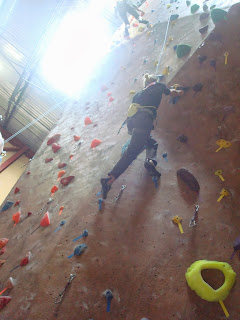
I do know that, on the wall, I am heavy beyond my strength to support, a new thing for me. What I take for granted that I can do is no longer a measure for actual ability; the brain has not yet registered my decline in things muscular. I guess aging comes as something of a surpise sometimes.
Sean introduces us to his friends and, they too, are residents of worlds I can only imagine. They convey the serenity of self-possession, confidence, proven strength, steady courage. They look straight into my eyes and do not shrink, deviate, or condescend. They are, however, intoxicated by the energy of youth, of imagining the possible, of meeting and mastering physical and intellectual challenges. They are royalty and grow in strength from the love they give to each other.
I touch what I believe to be a dream of humanity. They have opportunity and are all-in, going for it, unfettered by fear or anger, or better, supporting each other as each bumps into fear or other crippling emotion.
I cannot begin to measure the gratitude I feel, the humility, the awe.
I open to all of it.
We enjoy the rest of the day and the weekend with meals, conversations, places, and connections with young, optimistic, unbroken, joyous people who are making the most of their college years. It is a new thing for me, and I pause to wonder at this.
Can it be that such a thing is really possible? I will have to re-frame the boundaries of my imagination, will have let off the brakes, tear down some barriers, sidestep some "not possibles" for that to sink in.
But, when time runs short, such things become possible. Good examples help, and sometime children become teachers. Well, just about everything becomes a teacher if you think about it, open to it.

Thanks Sean. And sorry if I embarrassed you.
Much love,
Pops

He has been in college at the University of San Diego for the past three years, and has invited us over for Parent's Weekend. We will see him for the first time in his usual haunts: his dorm room and role as RA, the climbing gym, where he trains and works with the USD climbing club, the beach where he surfs, the classrooms where he works on his projects in the mechanical engineering program, and in the company of his girlfriend, Mina.
He will graduate this year, so it is important for us to go. Time has a way of doing that, of getting tight toward the end of things.
I am more and more aware that I inhabit a body that is slowly shutting down. It's a visceral knowledge that grows at the edges of my consciousness. The urgency to live because time is limited presses up against my diaphragm. It is insistent.
Once we are over the passes of the rugged coast range east of San Diego, we drop fast into the city. Traffic picks up and the pace of life quickens in the form of new BMWs, Mercedes, Lexuses (Lexi?), that travel in tight formation, tail gating at 80 miles per hour.
My Tucson sensibilities feel slow, limited, and a bit provincial.
Interstate 8 ends near the college and we exit. Sean is waiting for us at his dorm room. He has plans for the weekend. We will climb, go to the beach, eat, meet his girlfriend. But mostly, we will let him show us his life, let him be the tour guide to his world.
I am impressed by his room. He has a kitchen and a bathroom and runs his space well -- dishes in the racks, fridge stocked, TP on the role, towels hanging. There are two broken surf boards behind his couch. Conversation starters, no doubt. There is also the hand-made guitar made in the wood shop, the compressed air engine made in machine shop, the books on a course in genocide (not how to perpetrate, but how atrocities are caused and how questions of ethics run through our behavior or lack thereof). There is a white board with upcoming tasks outlined with dates and priorities. His is a rich, complex, and fast-paced life. The boy is growing up. And he is happy. Big hugs all around.
Sean radiates energy. He is passionate, all-in, on fire. And the feeling is contagious. What is possible takes shape in his orbit. He encourages others to dream.
Man. I have a lot to learn.
We move in, share some food, and begin the process of catching up. Tucson and my other life fades in favor of being here, of seeing things through Sean's eyes.
He makes us power pancakes with bananas in the morning before he takes us to the climbing gym. They are tasty and dense and new to me, like so much else.
I notice a book shelf that is suspended by shelf brackets and string nailed into drywall. I notice it is sagging under the weight. Sean explains that the forces pushing down have to be counter-acted by forces lifting or anchoring. It is a finite element enduring an ongoing moment of stress.
The room is full of the person -- the man -- he is becoming.
At the rock climbing wall, he sets me up on five seven, thinking that it will be manageable. I negotiate about a third of the wall before I freeze at a technical move and fall. I don't have the arms, the hands, the technique, or mental ability to handle the climb. My arms are thick with lactic acid as he lowers me off the climb. He sees, I think, for maybe the first time, my encroaching limitations of age. He and I will have to lower the bar so I can play at the gym. We renegotiate roles.
He is the master, I the neophyte.
And he is a master of the wall, an artist. He has been climbing seriously for seven years and has entered into an elite community of climbing elders.
He shows us some bouldering moves. I notice others at the gym watch in awe. I join them in awe, even though I don't know enough to fully appreciate what I am seeing. The ability to support one's weight relying only on the tips of fingers, the final joint, is not unlike dancers in toe shoes, takes years of practice, conditioning, training. The subtle sensibility necessary to fully appreciate what I am seeing eludes me. To really grasp what is behind his moves, I would have to spend years on the wall.
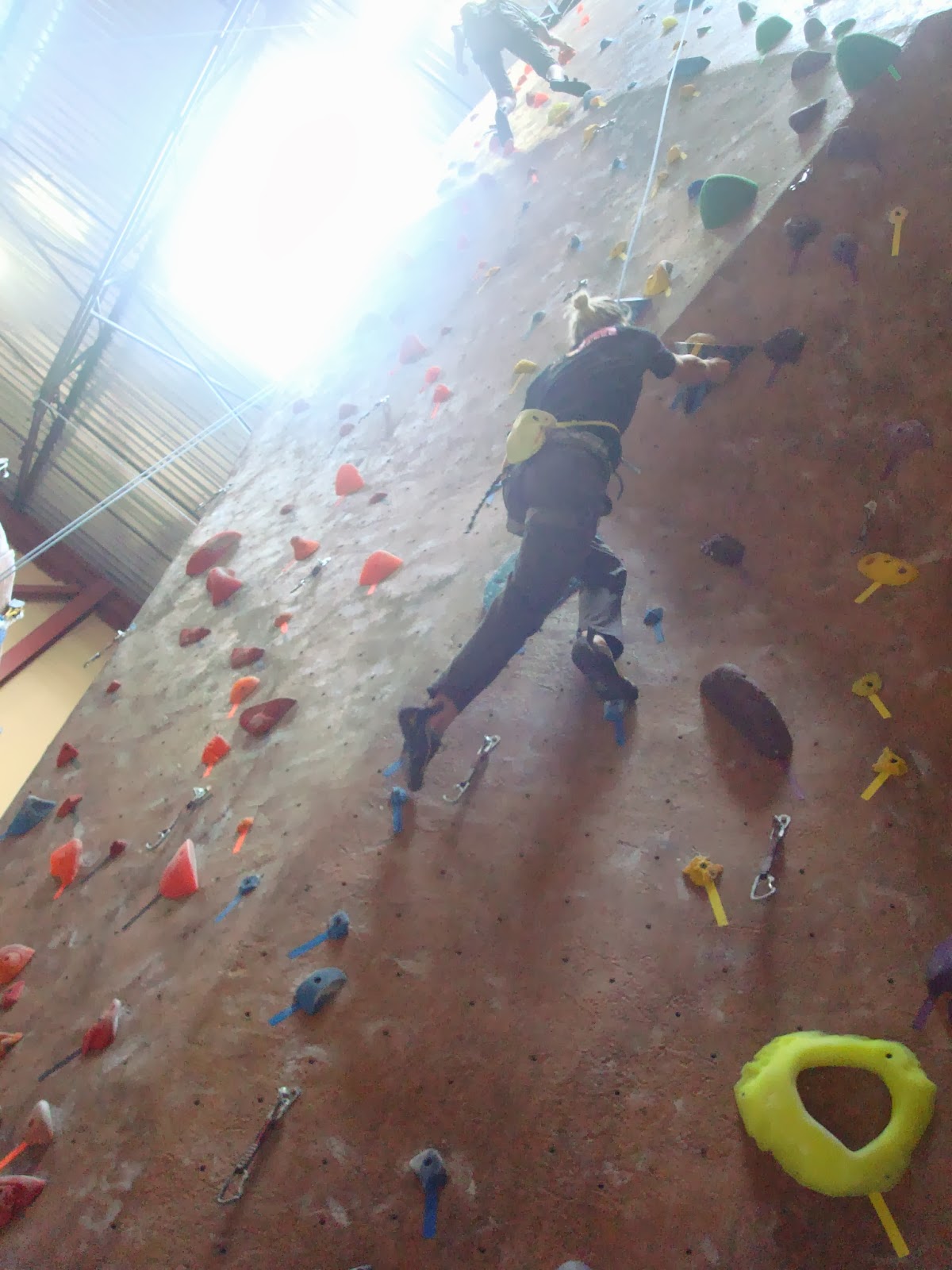
I do know that, on the wall, I am heavy beyond my strength to support, a new thing for me. What I take for granted that I can do is no longer a measure for actual ability; the brain has not yet registered my decline in things muscular. I guess aging comes as something of a surpise sometimes.
Sean introduces us to his friends and, they too, are residents of worlds I can only imagine. They convey the serenity of self-possession, confidence, proven strength, steady courage. They look straight into my eyes and do not shrink, deviate, or condescend. They are, however, intoxicated by the energy of youth, of imagining the possible, of meeting and mastering physical and intellectual challenges. They are royalty and grow in strength from the love they give to each other.
I touch what I believe to be a dream of humanity. They have opportunity and are all-in, going for it, unfettered by fear or anger, or better, supporting each other as each bumps into fear or other crippling emotion.
I cannot begin to measure the gratitude I feel, the humility, the awe.
I open to all of it.
We enjoy the rest of the day and the weekend with meals, conversations, places, and connections with young, optimistic, unbroken, joyous people who are making the most of their college years. It is a new thing for me, and I pause to wonder at this.
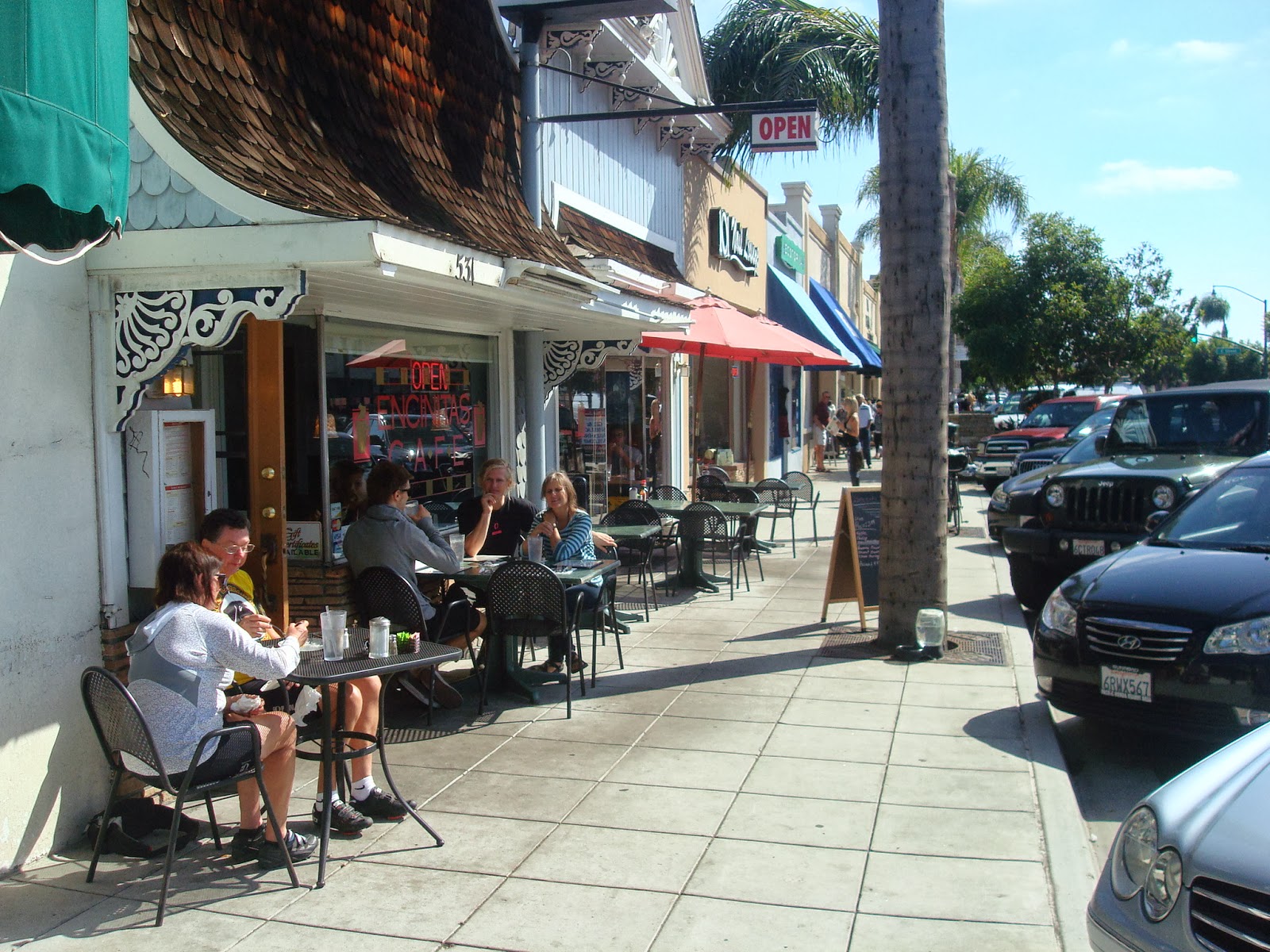
Can it be that such a thing is really possible? I will have to re-frame the boundaries of my imagination, will have let off the brakes, tear down some barriers, sidestep some "not possibles" for that to sink in.
But, when time runs short, such things become possible. Good examples help, and sometime children become teachers. Well, just about everything becomes a teacher if you think about it, open to it.

Thanks Sean. And sorry if I embarrassed you.
Much love,
Pops
Thursday, October 10, 2013
Connections
Six
"You know I'm a PA, not a doc," She said, over her glasses, pen poised above her clipboard.
"Yeah, but Doctor B. sounds better," I said.
She was finishing a screening for skin cancer. Routine stuff, and I had to be careful. She looked at me sternly and asked about sunscreen. She also asked why I refused to get new briefs. The light and spyglass travelled up and down my back, neck, arms, legs. She was not real happy about my tan lines and keratosis. I had some history -- squamous cell carcinoma, family melanoma, fair skinned, lax with sunscreen -- and had agreed to regular visits to my friendly dermatologist.
"You ever go to E-X-O?" I asked, trying to change the subject. Iwas referring to a new, happening coffee shop downtown, one that was getting lots of buzz. I had never been, but friends had pointed the place out me repeatedly. It came up in conversations that had nothing to do with coffee but that touched on exciting or energized ideas.
She perked up, stood taller, and stared at me. "I own it."
"Do you know anything about the film being shot near there?"
Another jerk back. "Yes, I know the film-maker. His wife is my best friend."
"Well, I run the workshops that the story they're filming came out of."
"Get outta here!" She said, and gave me a tentative punch on the shoulder. "Get outta here."
"Yeah, I know Troy and the camera guy and some of the crew."
"We had the wrap party at the cafe on Sunday. My band and I played for them."
"No way. What do you play?"
"Upright bass."
"You're too small to play upright."
"But I've got strong hands. I'm a rock climber."
"My son's a rock climber... Name is Sean."
"I know Sean. We work out together."
Now it was my turn. "Get outta here!"
"No, really. He comes to our coffee shop too."
"How come I've never been there?"
"What? Why did you ask me then if I'd been there?"
"I saw you downtown once and EXO just came to me. I don't know why."
"Get outta here. And you can call me Doc."
Five
I wasn't supposed to be there, but I was waiting for a reading to begin at the Poetry Center. It was the only time all year that I had stayed late here, on a Thursday
I was thinking about how hard it had been to get the Daily Wildcat to give some publicity to the prison story and the film that was coming out of it when Leslie and a friend walked in to the Little Chapel office. Leslie picked up a glossy magazine on the table.
"What is this magazine doing here?" Leslie asks with her usual why-the-hell tone.
"Oh, I had a piece published in there and gave the office a copy."
"It is any good."
"It's OK." I say. Leslie flips absently through some of the pages.
"You know Maggie wants to write," says Leslie, pointing at the other young woman sitting in the office.
"Really," I say.
"Yeah, she's into journalism, in the program here."
"Oh... Do you do anything with the Wildcat, the student paper?" I ask her.
Maggie nods. "I'm a reporter, and I'm looking for a story."
"Have you heard about the inmate who wrote a story that is being made into a film?"
She hopped up, walked over, and pulled out a chair, notebook and pen at the ready.
"Give me everything you've got."
Four
J. was never late and today was no exception. Her hair was wet though. She had just finished her workout and the wavy, shining, yellow cascade of it bounced as she walked up to our table. She wore tight, low-cut jeans and a sheer muslin blouse. The weave was loose so her outline shone through. It, like all of her, never stopped moving. She was on fire, lit from within, burning with vision.
Ten years before, her son Ben had died suddenly from an acute case of croup. She had been broken, but turned her grief into a crusade of sorts. She was the Grand Dame of Kindness. Hers was not a flaky, white light and butterflies for those who can afford a nice living kindness. No it was quite the opposite -- a gritty, street-smart kindness that is hard won. She had no time for meaningless fluff.
Both Troy and I stood for a hug.
"It's been a long time," she said, setting down her chai tea.
"I haven't played soccer for quite a while, and I don't see much of your parents now that they live in the Northwest."
"You still writing?" She asked.
"More teaching."
"I loved the poem we read at Ben's memorial service... What was it? 'On the Brink,' or something like that?"
"Long time ago. I don't know, don't even have a copy of it anymore. I lose all that stuff."
"I read the story though -- 'Acts of Kindness' -- and loved it. It's perfect to take into the schools to talk to the kids about learning that there are other ways to respond to trouble."
"We loved it too," said Troy. "So much so that we are making a film. It's really a simple but amazing story. We want it to go big."
"Well, I can help you with the funding," said J. "I have donors lined up right now looking for something like this. If I give them the word, you should have what you need."
"I want this to go to Sundance, to the Academy Awards. We're going to throw everything we have at it," Troy went on.
I sat back and watch the movers and shakers share contacts and strategies. They had energy and knew how to organize, network, make things happen. The two of them were now like a merger of great nation states and the momentum for the project grew.
"You know the kindness is not easy. And when you need it most is when you want to kill somebody. The point is to know that there is another way, that there are different possible outcomes to those crazy, critical, dangerous moments."
We shared about flipping people off on traffic and how that resulted in more flipping and more road rage.
But then there were some others times when we noticed that an apology went a long way, that when we each received one, we brushed off the offense as if it had never happened.
"Hey, I didn't see you back there. Sorry I cut you off."
"No problem! Have a good one......whuh?? whuh just happened?"
"Yeah, things can completely reverse course, change everything, flip a situation on its head."
"In the film," Troy continues, "the main character enters a struggling skate shop with the intention of stealing a board. Both characters eye each other and it looks like something bad is about to come down. That's the moment. And then, we don't know who, but one of them extends a hand, in a way, and the other responds. The guy in the shop gets a kick out out of helping and the kid gets a board. Then he pays it forward, for a while, til he forgets. That's where he gets caught."
"That sounds exactly like what we are looking for," says J. "I can't wait to hear about this."
"We start shooting in three weeks."
Both of them look at me and I excuse myself.
It's time for me to go to class, to teach.
Three
He is driving down a busy avenue in central Tucson when it comes on. A local radio show is featuring some writing by state prison inmates. A voice reads one of the stories. It is about a homeless kid who is angry. He can't find a job. He is out of money, has no place to stay, has just had a run-in with some thugs. He is hurt, and desperate. He is in Phoenix in the summer.
The only things he has that offer any relief from his spinning chatter of misery are his CD player and his skateboard. The CD player battery just died, so the kid is practicing tricks, hard. He is flipping, jumping, grinding, and cutting. On one landing, the board breaks.
It is hot, silent, dark.
The film-maker pulls over to listen to the story. It has cast a spell over him. He decides to make a film.
That week, he contacts the radio station, who puts him into contact with the reader, who puts him into contact with the inmate writer. The film-maker and the writer send letters back and forth. They work together on a screen play. The writer will be paid.
He gets released the day filming begins.
Two
"All right guys, your assignment for next week is to write on the topic 'acts of kindness' unless you are working on something else. You need to write something though."
Twelve men, all wearing orange jump suits write down the words of pads of lined paper. The circle, if you could call it that, is made up of broken desks, and the plastic chairs creak against the linoleum floor when the men scoot back.
"Now the idea here, is to tell a story, not just talk about how nice kindness is, or what a bad idea it might be. If you decide to write on this, you need to make a moment in your life come alive with your words. You're going to have to pick some experience and re-create it. Then bring it in next week and read to the group. We'll talk about how to make it better then."
"Right now, right here, I want you to think about a time when kindness showed up in your life, either from you or to you. Anything. Even the smallest thing. Sometimes those are the best things."
Some of the guys look out the window. The Arizona blue sky is blinding if your eyes are not adjusted.
One of the younger guys in the back says "I have an idea for that."
"OK," I say, "What is it?"
He starts out slow, but builds momentum telling us about a time when he was broke, homeless, out of friends, luck, and hope. Then some help was offered and he took it, took it to heart.
The men in the workshop nodded. One of the old timers, a leader, broke the silence. "I hear you bro. You got to go with that. It's good."
One
The door was open, and I stood there in a quandary. Should I step in to his office and introduce myself or just continue on with my work day. After all, I was just another grad student teacher and he was Pulitzer Prize nominated author. I had admired The Bus to Veracruz for both its lyricism and humor. This guy spoke to me, was good. But he was also busy. Too many people wanted a piece of him.
I don't know what propelled my feet to stand in the doorway or what possessed my mouth to smile and then say "Hey. I was wondering if you had a moment." But they did and I met the gaze of Richard Shelton.
We talked about the desert and about teaching. I told him I had been living in Mexico, was volunteering with the Sanctuary Movement and worked for Pima County Adult Education at the Federal Prison. I had a hard time telling him that I wanted to write. I had a hard time telling anyone, most of all myself, that. Good God, what if he threw me out with a sneer, saying "You know how many people approach me saying they want to write, looking to me as some kind of stepping stone for their petty, dilletante-ish pursuits?!
Instead, he looked at me with a hard, sharp gaze, one that was sizing me up somehow.
"You want to go out to a prison workshop sometime?" he asked.
He pointed at a box full of glossy magazines, copies of Walking Rain Reviews, and said, "Take one. Let me know what you think."
He has been doing the workshops for over twenty years at that point and continued to do them for another fifteen or so. Men from his workshops have become famous poets, teachers, and activists. I use their writing as texts in the classes at the University of Arizona.
So, I did take the journal. And we went to the prison. And I worked on my writing with Richard, now Dick.
I am nowhere near the teacher Dick is. I am nowhere near the poet. But I show up. I follow something that I can't explain, but that I know in my bones.
If you asked me why, I would say I do what I do for all the wrong reasons, but that doing so is what matters.
Thank you to all who have connected with me on this crazy Earthwalk. You have given me gifts that neither of us can fully understand, but that live within, through, and around us. Your connections have been a blessing. Now that is something I know.
A Dead End Called Solipsism
Yes, I am going crazy.
I fear that I have begun the long slide into dementia that my mother took before me. I am about the same age she was when her decline began.
It is subtle, just around the edges of my awareness. Fire has broken out on the perimeter of the realm. I can still function, but not so well.
I lose things, can't remember words, forget meetings, don't finish tasks. More people are unhappy with my performance at work. I spill my coffee more often. Conversations lose me. I can't understand the news, Megan's plans for the house in El Morro; my fingers no longer play the pieces I used to play on guitar; I am inappropriate in conversation.
Terror gestates just beneath my consciousness. I lapse into solitude that is my only refuge. More like solipsism, where even the self-talk fails to make sense.
So, yes, I am losing it. Like we all do eventually. And I have to look at things, clearly, directly, fully disclosed.
I have not lived my life. That is the problem. I have not read, have not shown up, have held back, and now have to pay the price or snap in the process. I have not faced my demons. I feel murderous as a result, and want to blame someone else. I want to run and not go quietly. That is one way.
Not such a good way.
The way I really want to enter into my decline is to turn it into beauty, to mindfully record the subtleties of the descent.
So what beauty can come from such a dead-end road, a road that only gets narrower and dimmer?
We will see. We will see.
Inmate B
Like many who come to the workshop, Inmate B saw himself as a bad-ass. He came trailing a reputation for quick kicks tied to a short fuse. From what I heard, it was well-deserved.
He had brought something to read and let me know that he wanted to go first.
After I went through greetings, introductions for the newbies, announcements, passed out writing pads, pens, a few books, magazines, thesauri, dictionaries, and gave a brief assignment, it was time to read. Inmate B sat up, held his writing pad in front, and adjusted his glasses.
"Forget my name/Forget my face/ Forget my arms/ My strong embrace" and on and on.
Quartets. Rhyming. Self pity. Ugh.
The rest of the guys in the workshop looked to me. They didn't want to say anything.
Uncomfortable silence.
I took an indirect path.
"So, what kind of piece is this?"
"A poem," one man volunteered.
"That's right. What kind of poem?"
"A rhyming verse poem," someone else added.
Inmate B seemed satisfied so far.
"What do you guys think about that form?"
"It's good for Hallmark Cards," another inmate offered, almost apologetically.
"Yes, it's a familiar form for love poems or family occasions, that kind of thing."
"They are usually too sappy and sentimental," a big black inmate said.
"And they feel forced. The words get jammed together and take over what you are trying to say."
Couldn't have said it better.
Inmate B stirred in his chair. I saw his knuckles go white with a strong squeeze. But he took notes.
The inmates began to offer up sharp observations about inverted structures, excessive abstraction, lack of sensory details, vividness of image, and general overload of sentiment.
Inmate B sat still and hard as a stone, except for his pen, which kept moving.
"Anything else?" He said.
"Keep working on it. But try free verse next time," I offered.
I find that free verse elicits more honest emotion, complexity, immediacy, surprise. It sometimes takes a while to stop wanting to be like and sound like Shelly or Longfellow and start sounding like one's self. As my running coach once said, "You can't be anywhere other than where you are, no matter how much you want might want to be."
Inmate B did not return to the workshop for a couple of months, but when he did, he brought a story about moonshine in Kentucky, and his conscription into the family business when he turned eleven. It wasn't perfect, but it resonated with the smells, sights, and language of the Appalachians. I published a revised version of the story in the prison magazine.
Since then, he has compiled a book length collection of stories and free verse poems.
I don't like all of them. I find many of them still bigoted, harsh, and smugly puerile. Others, however, offer a view into white poverty, closed family secrets, stunted opportunity, and a seething anger at institutions or intellectuals.
"I would have gotten mad a few years ago," he said to me recently, after finding a Post It on one his drafts that said "Low Priority. I don't much like this piece."
I had written that as directions to the volunteer typist, and she had forgotten to remove it.
"But now I can take it. I know you eggheads are full of shit." he smiled, a not completely ironic smile.
"It's true," I said. "I didn't like that piece. It is loaded with cliche and pointless, irritating meanness."
"But I keep coming back, don't I?"
" Yes you do. Me too" I said, knowing that pronoun was grammatically wrong, but right for the moment.
Subscribe to:
Posts (Atom)