Thursday, July 25, 2013

Makin' it up as I Go Along


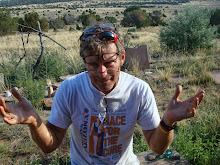
Building the deck on the guesthouse in El Morro, New Mexico this summer has pushed the envelope of my physical strength and carpentry skills past the edge and into new territory. I don't know how to do half of what I am trying to do; my elbow, back, neck, wrist, and shoulder throb, waking me up. I have not done this before. I have spent my work life teaching, not wood working.

But the pieces are coming together in spite of myself. Sure, there are the mistakes: the missed measurements, the broken finger nail, the ugly joint. But time and contact and persistence lead to progress.


Some of the boards even line up -- square, plumb, and level.


It is not totally my doing, even though I am sawing the wood and hammering the nails. The results are out of my control. I just show up and put in time and effort. The product is something that comes to me from an ongoing surprise called the future. Sometimes it delivers things I like. Other times ... well, you know what hits the fan.


Moving forward into all this unknown territory scares and excites me. The steps into the future also scare and excite me. I don't know where I am going, where I will live, what I will do for a livelihood, how to handle conflicting emotions, what steps to take. Part of this uncharted future is what I do for a living. As a teacher, I am asked to take on more responsibility, more tasks, handle more students, and do it all without the perks of a real office, tenure, or pay increase. My workload has increased while the number of colleagues has decreased by over half. My job has become an ongoing humiliation of doing "more with less."

The lack of administrative support is just part of a general decline in social support of education. I hate to say it, but I take this personally, and have become discouraged, demoralized even. I am weary of responsibility and "all that caring," as Stanley Kunitz says in his poem "The Long Boat."

I guess this is part of what people call a mid life crisis, rushing emotions that precede the final descent into old age. I feel love -- love of my students, of the need to learn to think and to communicate effectively. I feel fear -- fear that learning to think has been replaced by an education of memorizing facts, facts that are obsolete the day after the test is taken. The brave new world looks menacing, and dangerous, even though I know it is also filled with potential.

I  admit that I am out of control. I need time to think but time is short and I need to act without knowing what, exactly, to do. I am not ready to surrender all the delights of this lovely planet, this gift of a life. But something has to change, to die, to attain the renewal I seek, I need.


I don't possess the knowledge or experience to guide me as the work progresses. I do have some strength and trust. That seems to serve me better anyway. There are forks in the road: the heart calls from one; duty and commitments call from the other. Momentum of old ways fails to provide what I need.


Change confronts me. I am in a dilemma. Do what I need to do to feel alive or stay comfortable but dead in old ways of doing things? Those old ways no longer answer the questions I need to answer or provide insight into what I want to do. Each option carries a benefit and a cost. There is no certainty of reward waiting behind either horn of this dilemma.

The weather here in July is unstable. There are storms inside and out. Summer winds will end soon and I hope I have what I need to cope with the stresses of work, family, bills -- all those necessities. I will have to face the demons and fears as the school year begins, as I once again engage with the grinding inevitability of how my life will progress. I don't know if I have the courage to leave that which no longer sustains.


Where I will end up or what I will be doing remains a puzzle yet to be solved. I can't see ahead, but I know I need to show up, put in the time, act with integrity and passion and the results will follow. It is hard not to worry, just a bit, about the consequences of change. That makes me feel old.

It aint over yet and there is no map for where I will go. Joy and suffering converge in an open, broken, grateful beating heart.

Monday, July 8, 2013

"It Looks Bad," He Said. "Real Bad."*


The Ramah Navajo Reservation blends a mix of people into a strange salad of human types. There are the Navajo, of course, and they outnumber everyone else, but in the checkerboard of land ownership, there are ranchers, hippies, artists, rednecks, drifters, misfits, eccentrics, mountain lions, bears, bobcats, and wolves, though the wolves are behind a fence out in Candy Kitchen (animals are people too, in my book). Candy Kitchen was named for the bootlegged white lightning that was distilled there during Prohibition.

All of us here like to wave discreetly at each other when we pass on the highway. We don't cotton well to any lack of civility.

There are also the Mormons. They live mainly in the town of Ramah, where my car rests next to a wood-burning, gasified 1972 Chevrolet S-10 pick-up truck. Yes, this truck runs on wood, about a pound of wood per 3 miles or so of real motorized movement. That is much better than my fancy Japanese, all-wheel-drive, 2.5 liter horizontally opposed four cylinder Boxer engine speed machine. It is beneath a large cottonwood with the hood up  enjoying the stiff sweet breeze and enduring the scrutiny of Jodie, the head mechanic and owner of the shop, and a couple of Zuni guys, Mike and Frank. They are all shaking their heads.

I roll up on my skinny tired road bike, exhausted from fighting the wind. They are not impressed. Mike and Frank walk over to the shop to let Jodie give me the bad news.

"It's bad. Real bad."

He lets that soak in.

Then he says "We took off the valve covers and found aluminum shavings all through the oil system."

He looks at me like a patient parent explaining that a beloved pet has died.

"You're going to need a new engine."

The spear penetrates fully into my heart before it twists to let the blood and viscera poor onto the New Mexico dust. My beloved car has died and will not move from this place unless I sacrifice (again) my financial viability to have transportation. I want to rail against Fuji Industries, my fate, God, the universe, my lack of sleep, and sore butt. It just isn't fair.

Oh well. Oh hell. I suck it up. I now need to find a phone or WiFi or some way to search the Cosmos for a 2002 Subaru Outback engine -- the Holy Grail, the Golden Fleece, the Rosetta Stone of my next couple of days.

My quest begins.


* A nod to Raymond Carver and his Poem "What the Doctor Told Me."

(To be continued....)

Thursday, June 6, 2013

Soob Story


Sand blows across the road. It stings when it strikes exposed skin. I am riding my bike along New Mexico State Highway 53 to JRL Enterprises, an auto repair shop. My dead Subaru wagon is there, and I need to discuss the new engine I will need to get the car running and to get me home. This has to be a face-to-face meeting because I have no phone service here. I am in a big, empty blank on  their coverage map. No phone, no internet. Just the wind and words. The wind is gusting to 40 mph and it howls at me, straight on. Unless you have felt it, there is no way to know what riding into a wind such as this feels like.

That is what is in June up here. The wind comes out of the west and really begins to blow mid morning. It picks up force through the day, peaking in the afternoon, like about now. 

Gravel trucks scream past with full loads. They carry tons of the white, lime-impregnated gravel to the power plants. The gravel serves to scrub the emissions of the coal fired plants on the Navajo Reservation. The power helps the uranium and other extractive operations in the Four Corners area. 

They pull over to give me room if they can. When they can’t, because of oncoming traffic, I am sucked into their draft before being dropped once again into the furious wind.I have to work to keep the bike from being thrown into the ditch.

I have twelve miles to go. It’s a slow, long haul, but I know I will get there. 

The weather is not the only thing that is harsh up here. Cibola County is one of the poorest counties in New Mexico. It's hard to find work, to make a living. But that adversity makes for tough, resourceful, and friendly people. We have to depend on each other up here.

People don't suffer complaining or selfish fools much. There is too much to get done. 

I have to figure out how to get my car fixed. It is up to me, "Aint nobody goin to help you carry your load," as an old spiritual says. That feels true, but only in part. I have help, and I depend on others. What I have to remember is to do my part, right now.

So I lean into the wind and wonder how it is all going to work, where this particular crisis is going to end up, how I can best play my role as giver and receiver. The wind, in other words, is my teacher. It says drop your expectation that life be easy. Get over the fact that you have to meet, endure, and enjoy, the slings and arrows of your outrageous misfortune. You are the bug today rather than the windshield. Lean into the work. It is your curriculum for now. Your misery has no company. 

The remoteness and openness of this part of the world make cars a survival requirement. It is fifty miles to hardware, food, and car parts. 

I don't mind the remoteness though. I like it that way. I can't live for long in a city. The air here is clean, the sun clear and hot, the wind incessant. But the car thing... that's a burr under my bike shorts.

I know that soon I will be mobile again, back in the company of engine operators, but today I am free to brush against the elements, to breathe directly the scent of pinon and diesel fumes. The contact is direct, honest, and unforgiving.  


Friday, May 24, 2013

Durango Dreamin'


I am standing on a corner in Gallup (not Winslow). I have in my grocery bag a nice slice of Gouda cheese ($9.95), some pita chips ($4.50) and an add-shot Starbuck's red-eye ($3.00). Ah, but what is money when the soul is on a quest?

People stare from  the interiors of their dusty pick-ups, paint oxidized Nissans, and sway-backed mini vans. They likely wonder what the hell some old guy in a tie-dyed shirt, sandals, and bike messenger bag is doing holding down the curb in between Home Depot, Wal Mart, and Big Lots.

Only yuppies bound for Colorado are driving Subarus. Those Subies have racks with nice bikes, kayaks, cargo carriers full of climbing gear. They are the horses of my tribe, the means to the end of natural beauty seen through the eyes of endurance challenge. They are going by too fast to notice the incongruity of a stranded traveler on foot at a crossroads where cars rule.

My Suby is busted, in the shop, due soon for open heart short block, crank-case work.


In the meantime I wait for the pedestrian walk light that never comes. I can see a faint trace of a crosswalk that leads to nowhere on the other side of the six-lane road. Not many people seem to walk around here. When I do finally get a walk light, several trucks have to swerve to avoid me, never having before encountered a pedestrian.

What is it about this crossroads? It has to be one of the most God-forsaken strip malls on the planet. Franchises and corporate marketing hype rule. It's windy and dusty and only a few hardscrabble grasses poke their heads up out of the cracks. Ravens play on the wind.


Last year, at this very same place, I lost my wallet. Now, joining the ranks of street people is something I recommend from time to time, if for no other reason than to see there is scant padding between them and us, the busy, lucky ones.

I cannot hide my yuppiness on this corner, nor can I fully justify my reasons for being here.

Tomorrow morning, if I make it, I will ride from Durango to Silverton on my skinny-tired bike. The ride is a kind John Henry re-match, only we will be on bikes, racing the steam engine. We will ascend to almost 11,000 feet over two passes, Coal Bank, and Molas. I will do it on about four hours of sleep in three days. But that is the way a spiritual quest is supposed to go.

I have been training for six months. Hours of slogging up Mount Lemmon, near Tucson, rides in the Gila Wilderness near Silver City New Mexico, and fantasy-filled commutes to work. 

The Iron Horse is one of the first items on my bucket list, that collection of things to live before I die. I am paying quite the price to get there, and others are helping me along with superhuman kindness and generosity.

Kate Brown, God bless her, has loaned me her truck. True, it needs brakes to be safe on the steep mountain grades between me and Durango, but it is transportation, the difference between making it and not. Strangers too, when they see me busted on the side of the road, have been kind, especially the folk in Zuni at the 24-hour Quick Stop. Friends have sent sympathetic texts that rain down sporadically when I find the rare cell phone hot spot. The Meeg-a-Beeg has given her blessing to my crazy pilgrimage. The gods are smiling.


I want to do this thing. And I am obligated by karmic debt to enjoy it, soak it in, remember it for the stories to come.

Andale! To the moon rising over the mountain ridge, the shriek of the steam engine as it leaves the station, the cold, long slog over Molas Pass, and wicked descent into Silverton. If this is a dream, let it continue. I never want to wake up. 


Monday, May 6, 2013

What to do About Simone -- A Cat Koan*


My cat, Simone, sees things that I don't. She swipes at the air and leaps after phantoms just out of her reach. Sometimes she reaches under something that is totally invisible, curling her paw beneath an imaginary cabinet or sofa, like a mime creating the object, wall, or window that is not there.

I wonder if she is cat-crazy. Or if I am just too stuck in material carnality to perceive that which is more subtle than the here-and-now, beefy, luggish, concrete. She is a smart cat.

She might have access to colors I don't see, to sounds too high or low for my ears to detect, to touch so sensitive it perceives temperatures or pressure or heat or cold out of my range of noticing.

If I had to infer what she is looking for, it might be her brother who died a while back. He may be reaching for her from the other side of something I don't understand. Sometimes I see him, and others who are no longer here, in dreams. Simone might be able to dream while she is awake

They say that some yogis can see auras, that psychics can see angels that follow us around trying to get a word in edgewise between the chatter of mental distraction, that medical intuitives can see into the body.

Most wise teachers agree that we (the untutored) don't SEE what is in front of us. Some also say that when the student is ready, the cat will appear.

Still I don't know what to do about Simone.

Maybe I should take her to a cat counselor, a feline psychotherapist, a kitty curandera.

Or I could get down to her level and try to see what is going on down there. I have tried to talk to her, but she just looks at me, with great patience and mild pity.


Someone with business sense would post her on YouTube and turn her into a cyber celebrity.

Or I could just ignore the her odd behaviors and carry on, apologizing to the sensible ones for my crazy cat.

Either way, she doesn't seem to care what I think. She seems happy responding to things I don't grasp. What to do about such a thing? What to do when a heart goes wild at the scent of possibility? How to react when the knees go weak and I want to kneel at the wonder of it all? What to say when the body can't find words that need to be said, the urgency pounding at the walls of a container due for opening?

Something has broken open in me and the answer of what to do, part of me knows, lies in listening to a crazy cat who see things I have not yet learned to see.


*Apologies to all who are tired of cat/dog/pet cuteness video saturation.


Saturday, April 27, 2013

The Perils of the Heart (Fiction Excerpt )


Chapter One: The Hitch Hiker

Since you asked me what I was doing out here hitching a ride in the cold, I’ll tell you. Just turn up the heat, please. And thanks for the ride. Funny how I don’t feel so cold when there is no hope of warming up. Put me in a car though, or in somebody’s living room, and right away I feel cold. Outside I just get used to it, or numb. 

It’s a long drive to Albuquerque, and if you’re going that far, I’ll take the lift.

So yeah, I'm going a long way in this weather, and my reasons for being out here are ... complicated... I guess you could say. It's a long story. If you want to hear about it, I’d be glad to tell it, but you will need some time. It looks like the day is still young, and the drive will take a while. 

Now, I’m going to lay it out for you, not editing so much. You seem like a pretty smart guy, so I won’t spare you the edges. 

Back then, before all this started, I had gotten through school, I had a pretty good job, was married, stable. Not exactly happy, but getting along if you know what I mean. The bills got paid and I was responsible. I lived in a big city, not like this place. I mean here there is nothing but sky, lava flows, red sandstone, and wind. The winds just never stops blowing. But it’s where tumbleweeds like me end up.

You can be as sad as you want here, but everyone is so busy trying to survive they don’t encourage your staying that way. Thanks for the heat by the way. That feels good. I forget how cold I am.

You need to understand something: there is a wild way of being that runs counter to sensibility. Because it cannot be tamed, living like this leads to trouble. I guess that’s where I went wrong, as some people would see it, or right, as my heart tells me. But following something as tenuous and insubstantial as the heart has led to my standing here, by this road, alone, unforgiven by almost everyone who knows me. It is cold and I have nothing left, nothing, that is except memories and a certainty that I had no choice, that I would do it all again if I had it to do over.

It was a dream, of course, and its effect on me was no less that being struck by a truck or lightning, only you couldn't see it. It was like the solar flares that no one can see until they show up as shimmering curtains of light in the atmosphere. You can't see or touch them, but they are there, as real as rocks, nonetheless. This dream took hold of me in a stranglehold. Either I would follow it or I would die. Simple as that.

Pardon me. I just need to blow some warm air into my hands here. Whew. I get the shivers sometimes. OK, where was I?  Like most things, though, dreams can grow cold after a while if you don't care for them. When it was still alive, on fire, I felt good. 

And dreams often lead to people. One of these was a woman, and we met as a blue moon rose red over the rocks on a high plateau New Mexico. I had a flask of tequila, and she sang a song about tequila making a woman's clothes come off. She meant it to be funny, but all of a sudden I felt that stranglehold again. The body has its own language sometimes and it rises up to lay down the law, deliver that old ultimatum. All that mattered was that moment and the rushing rivers of chemicals and electricity. I felt like I would die from the thrill of it or perish from the denial of it. It wasn't going to go well either way, as far as things staying the same.No matter what happened, the thought of her was there, in the background. It would not leave me alone.

To Be Continued...

[From here, the story switches to the driver's (a straight-laced college teacher) perspective. He is taking the long way home and has no idea how this story, told by a hitch-hiking transient, will affect him.]

Wednesday, April 17, 2013

Hamlet, Fortinbras, and the Third Way


As the years go by, I notice that more and more of my peers, mainly middle-aged white guys, are retiring. I guess that’s what many white men (and women) get to do at this age. Some of us don’t get to do that and have to go on making a living to support kids in college, old cars that need repair, pay for health insurance, rent, and bags of bulk beans to cook over a modest campfire under the local bridge.

My peers, needless to say, sometimes puzzle me with their smug complacency. I (the somewhat bitter wage-slave "I") want to slap them; I want to DO something, anything. But I (the better "I") want to understand them too, to see how this self-absorbed soaking up of comfort is possible and figure out what to do about it.

So, these lucky ones, I have noticed, tend to share a kind of passive tolerance of the way things are. “Hey,” they say, “Things look fine to me. What’s your beef?”

One of them, who is quite educated, at an Ivy League School no less, and, not so surprisingly, is fond of quoting and pontificating on the merits of hedonism and passivity. He says things like, “There a have always been wars and alpha dogs and injustice and pestilence; they are the ways of this world. It’s best not to trouble yourself too much with them. Plus, who am I to tell anyone how to do things? I just don’t know for sure what is best.” They point to such great philosophers as H.L. Menken who wrote “Moral certainty is always a sign of cultural inferiority. The more uncivilized the man, the surer he is that he knows precisely what is right and what is wrong. All human progress, even in morals, has been the work of men who have doubted the current moral values, not of men who have whooped them up and tried to enforce them. The truly civilized man is always skeptical and tolerant, in this field as in all others. His culture is based on ‘I am not too sure.’"

We can call this figure Hamlet.

Well, of course, I think. Who knows anything for sure? But is that an excuse to sit and do nothing if you have even the slightest inkling of what is happening to our fellow humans or our lovely planet? I will not enumerate the litany of crises facing humanity in the coming years. If one peeks, even briefly, at headlines, one sees a careening disaster in motion. And here, one can either despair and opt to be skewered on the horns of hedonism or nihilism. Or one can act, sometimes rashly, inspired by such thinkers as Edward Abbey who writes “Sentiment without action is the ruin of the soul.”

A logical extreme of this worldview is Fortinbras, the "man of action," the "Decider," if we want to invoke a recent president.

In other words, one might be tempted to look at the question of reflection vs. action and answer it with an either/or argument: either “I don’t know what is best to do, so I will do nothing,” or “something must be done, so I’ll do the first thing to comes to mind, right or wrong.”

In spite of this particularly Western way of understanding things, one can imagine a third way, a both/and of reflection and action. Some people criticize meditation as “navel gazing,” but the Dalai Lama doesn’t see it that way. He says “the most important meditation is critical thinking – followed by action.”

To my mind, there are few icons of literature who embody or characterize this complex, paradoxical, dynamic process. 

Even without the telling detail of a name to go with the idea, I like avoiding the horns of a dilemma with a third way. It’s a both/and kind of thing, a dynamic system of thinking and action. 

Of course, now we have to figure out what he means by critical thinking, and, sadly, that is not something that is a priority to framers of educational policy – teachers, yes, but not policy makers.

Maybe, when I retire, Hamlet, Fortinbras, and I can chat and then do something good. I'd like that too.