Saturday, February 7, 2015
Don't Go There?
People don't like to talk about it, don't want to hear about it either. They just want something pleasant to fill the time.
Widening gaps in wealth, declining opportunities in education, climate change, cyber attacks -- all of it just seems to be too much, over the top.
Even if there is a flicker of interest, the talk goes along the lines of "it's always been like that," or "it's not a good time to rock the boat," or "I'm doing OK for now and don't need to really act or wake up."
Those are just a few the messages I get to change the subject.
And they have started to wear me down.
I am so tired that I can barely move in spite of losing ground in most of the areas of my life.
A course I designed has been canned because it costs too much. Never mind that the data show better retention, faster time to degree, and improved achievement. Or that national award.
My bosses just go along with whatever comes down from the tower of administrators and encourage me to do the same.
My chosen field, education, operates on fundamentally wrong-headed assumptions about the values of testing. The whole testing enterprise and "data driven" frenzy has wrecked what I think is good about education: problem solving, creative expression, and critical thinking.
There just "isn't time for those things."
Corporations and billionaires tailor political structures to better control what is left of a democratic system.
Prison gates shut tight on the poor, the marginalized, the mentally ill, the throw-away people.
A prison industrial complex has grown into big money as it grooms governments to lock up more and more as a way to make money off of the declining education and work opportunities.
Even those who can find jobs, can't make ends meet because wages are so low.
It is a bad time to run a small business or to work for a living in America.
And only a very few are willing to talk or think about the issues, much less act on them.
So I keep it all to myself and try not to offend polite conversation.
The truth of things is usually too much to hear, too unpleasant, to close to the bone.
And so we coast along...
Until a story pulls us in enough to entertain even the most aversive and unpleasant of facts.
It's up to the writers, movie makers, and artists to tell the tales that might matter enough to push others to take a stand.

Wednesday, February 4, 2015
My Trip to Visit My Father Who Has Alzheimer's (work in progress)
Gus made Tater Tot casserole for the church dinner. He and the girls took it to feed the homeless. That meant The Bear and I were left at the Road House with the paid programming that followed the Packers game.
The Bear didn't much mind, or better said, he didn't complain. He is used to being left in front of the TV as Gus's family goes about their business of high school sports, boot camp workouts, homework, errands, and Midwest socializing.
Gus's dinner does not include many green leafy vegetables. It's like most of the meals I will have on my trip to the visit The Bear, but that is fine. I'm used to Wisconsin food, and have lived on it most of my life.
I'm here now from Arizona, where I live, to see my father, who has just received his official diagnosis of Alzheimer's. I've brought him up to my brother's from where he lives in Janesville, thirty miles to the south. The farmland along the back roads is frozen and snow covered. Ponds are slick, shining sheets of black ice.
We saw three wild turkeys on the way up.
I have never, in many years of living in Wisconsin, seen wild turkeys. Yet, there they were, off the side of the road, crossing a corn field stubble.
I'm staying with the Bear and his new wife Linda. They have a guest room that faces the street in a Victorian brick house. The old furnace and steam-fed radiators can't keep up with the cold. They clank all night. Flannel sheets and a pile of qulits help with the cold.
After Gus and his family leave for the church dinner, The Bear and I decide to hit the road too. He needs help with his jacket, but stands and uses the bathroom before we go. As we walk in the cold out to little rental car, I hold his elbow. He is stooped from the Parkinson's and not so good with stairs. The driveway is shoveled but slick with patches of ice.
We make it to the car, and I help him in. Once settled I ask if he wants to take a road trip rather than go home.
"Hell yes," he says.
"How about the brewery over in New Glarus?"
He nods.
On the way we take a tour of reminiscence through downtown, the downtown of my adolescence and his glory days as town councilman. We drive past the old house. We talk about things that happened in places in the town -- a canoe race that we lost, neighbors who divorced, houses I helped paint for work while in college, times we worked together on the family house.
The town has changed, seems so much smaller than in my mind's eye, my dream life.
Once on the highway, I gun the little car. The Bear likes that, has always liked cars,
I hated them. He worked for Triple A.
Now, we just enjoy the view as the shadows lengthen.
He is more lucid than people think. My brothers and sisters tell me he is "too gone" for conversation. I disagree. In the car, we have plenty of time to think in silence, plenty of time to process. He tells me he is concerned about US fiscal policies, not exactly the subject of a feeble mind.
His age and decline in function has softened him. I tell him I am sorry for having been such an asshole of a son.
"It's alright," he says. "Make the most of the days you have."
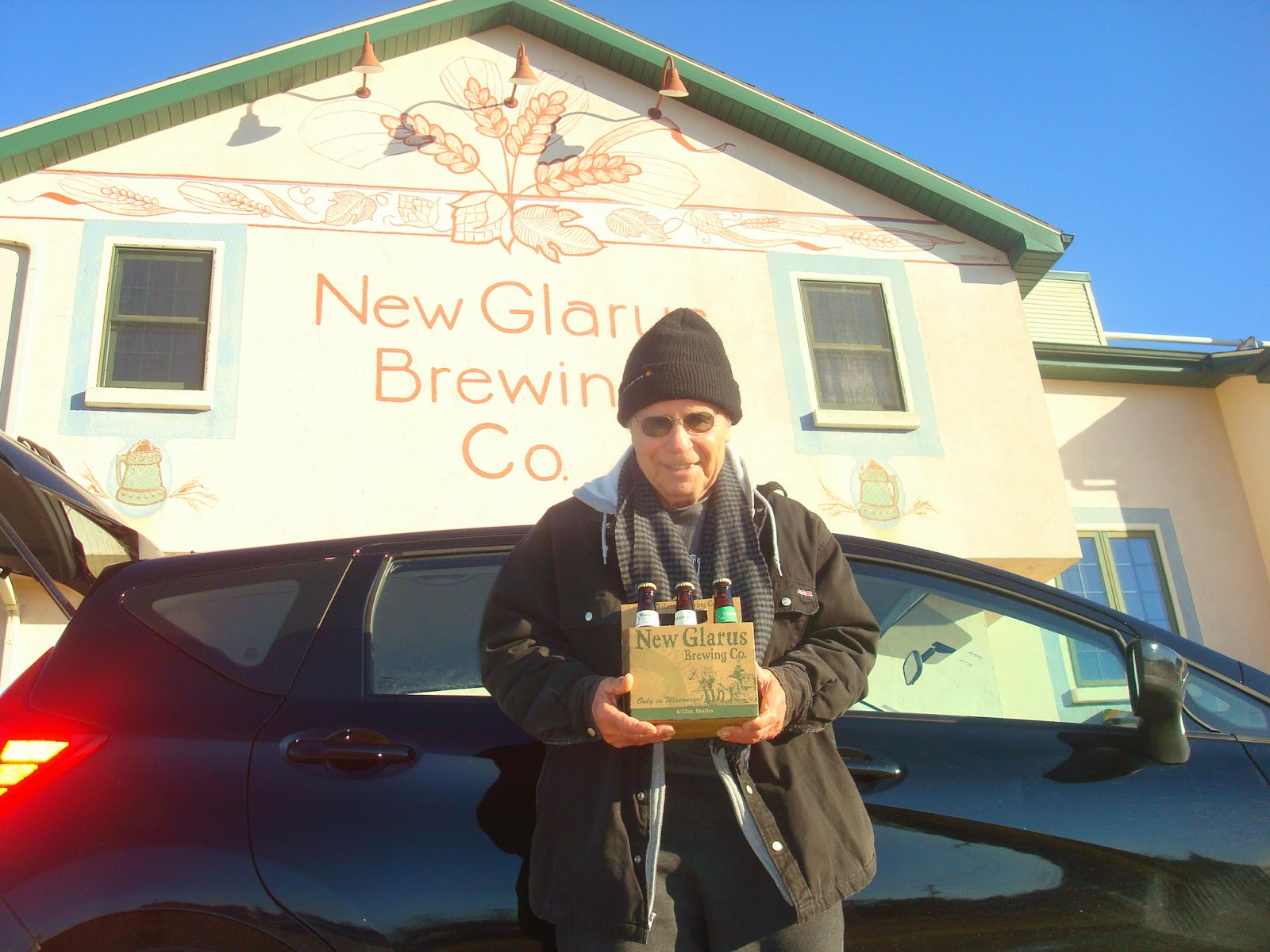
In New Glarus, the brewery is closed and it's getting dark. But a grocery that sells the brew is open, so we go in. The Bear uses the grocery cart as his walker and we find the display in the back of the store. They let us mix and match single brews for a six pack. I get a Fat Squirrel and a Spotted Cow. The Bear picks out a Black Top. He doesn't drink, so doesn't really care what they will taste like.
I take a picture of him in front of the brewery.
On the way back home, we call some of my siblings A few of them are having trouble. Maggie had serious issues with Earl. She is distraught. The Bear can't stop being the father.
"Sweetheart, you let me know if you want me to come down there to help. I can come down if you need me. You just let me know."
This comes from a man who cannot remember where he is, much less drive a car to Florida, yet his role as father won't quit.
As we roll through the hills, I tell him about my own struggles with parenting, with marriage. I stay away from money, because I don't want him to worry. I tell him about my writing projects. He doesn't scowl like he did when he was younger, stronger. He was disappointed that I did not follow him into the military, but has come to terms with my choices.
I talk to him like I have always wanted to talk to him -- openly, with emotions like fear and anger and shame. He listens, hears me. Nods. Asks questions.
He tells me things I never knew about him, about his own dreams. His dream to be a pilot. His days as a lineman in North Dakota in the winter. His courtship of my mother.
I see monstrous hay bales left in a field out the window. They are frosted with snow as the sun sets and a near full moon rises.
I have so many amends to make. I have been too hard on Wisconsin. I have been an arrogant prick to my dad. I am such a beginner with being the son who comes to visit. How can I tell him that, in many ways, I have failed? Failed professionally. Failed to become the writer I wanted to be. Failed to become the father and husband I wanted to be.
And I wonder if I am next, if the Alzheimer's that wracks my father will soon lower its hood on me.
The radio say it's zero degrees out there in the cold fields as we wind our way back to my father's home.
My dad is happy with his new bride. She takes care of him. I guess that's what matters. My sibs don't visit him, don't like his wife. haven't gotten over my mom's death. Fear losing inheritance. Or whatever it is. I sleep in the basement. It's cool. I wait for the bats. Text my beloved.
I don't talk to The Bear about depression and how I feel it is aptly named. The whole system slows down. Thoughts don't happen. Connections don't get made.
I think about my nieces. The youngest of them, Kortney, sits with my dad where he sits in front of their TV. She is the only one who seems to see him. But she is getting older and now plays solitaire on her I-Pad.
When I leave him to return to my own home, he is hunched over, listening, watching, waiting.
Beneath the Wheels
Sean took me to see the other San Diego last Saturday.
We left the beach area, the La Jolla / Scripps dreamland and went south and inland, past the airport, the harbor. We rode our bikes down to the loading docks, the bridges, the industrial parts of the city.
Like many cities, San Diego is divided between the haves and have nots. Not surprisingly, the haves get to tell their side of the city story more than the others. San Diego, to outsiders, is beach houses, surfing, sunsets, recreation on bikes, skate boards, boats, hang gliders, fast cars, scuba.
It's a fit man's paradise of tight, tanned asses and tidy utopias. Milk, honey, and money.Ego, self-absorption, Me-Me.
Of course, there are other stories, other San Diegos. Somebody has to work once in a while, after all. For so much wealth to collect at the upper crust, some has to be funneled from down below.
There are tents belonging to homeless people on the sidewalks near the stadium. Hookers flirt with drug dealers in sleek cars with dark tinted windows. Drud addicts lie on the sidewalk, filthy with the grime of the streets and their bodily secretions.
The dream didn't work for them.
And then there are the activists, the ones who work with the invisible San Diego. One of their projects, an attempt to tell the story that is seldom told is in Barrio Logan, Chicano Park. There, artists have put together images that show struggle for a place to stand, a working wage, decent education, an identity for the invisibles.
Some of the murals tower over viewers on columns that support the Coronado Bridge. They are powerful in color and design, with messages of action, character, and work. They are not the ethos of fun and privilege. These are the stories of the marginalized, the outsiders, the underclasses.


But they are also beautiful, erotic, and portray the many forms love can take. The art shows possibility in alternatives, asks the viewers to imagine potential.

Interestingly, the park was quiet, except for some men pushing shopping carts or bikes loaded with the supplies necessary for life on the streets. I saw no tourists other than us, no photographers, no elite museum patrons. The common good seems very out of fashion here in So-Cal.
The quality of the murals was the equal of those I have seen at the Museo be Bellas Artes in Mexico City, but no entry fee was charged here.
This art required scaffolding, prep work, paint, skill, and long days of hard work, yet they stood here, outside, free for the taking.
And few seemed to care.
I guess that says something about power and how we view the possibility of social change.
The artists and activists are my heroes. They carry on against a stream of thought that is all but impossible to overcome. They swim up the stream fed by privilege, wealth, advertising, powerful narratives of corporate control.
Power does rest with the people, they say.
It's waiting there for us when we wake up, when we remember, when we can't take the injustice any more.
Tuesday, January 27, 2015
Get Up and Do It Again
It is still dark on a Saturday morning, and Simone, the cat, snores contentedly at the foot of the bed. I want the darkness never to end, to let me remain here in half sleep. But that is not what's happening today.
Demons have pinned me to the sheets. My gut is grinding in fear. My arms and legs feel like lead, but I have to lift them, to move, to get ready to go out to the prison.
These mornings are tense at home. I am angry, irritated, in a hurry. I need to be alone with the prison that hangs over me, but Megan wants to talk, wants help with house tasks, wants, deservedly so, to have some Saturday time together.
I can't blame her, but neither can I tell her about the snakes in my head, the twisting pressure on my heart, the pending doom.
My mind speaks only curses. Something here is dangerous, better left alone. It coils, hisses, threatens.
But I turn away from the demons and give her some of the morning.
We take a bike ride to a cafe so we can make plans, have the conversations married couples have.
I try to forget.
As soon as I can, I enter the transition of going to the prison. I put on my worn-in-the-seat prison pants, shoes, conservative button-down shirt, nerdy reading glasses, and get the plastic tub that will contain the supplies that I have to pick up on the way: books, magazines, pens, dictionaries, thesauri, folders. An inmate wants a copy of Dante's Inferno. Another wants A Course in Miracles. Another wants a book about writing poetry. Many want erotic novels like Fifty Shades of Gray or The Girl With the Dragon Tattoo.
I stop at an office supply store and a couple of used book stores. I also get something to eat. It's going to be a while before I am back out.
A waitress at the taco joint knows my routine, knows where I am going, has a relative who is incarcerated, and treats me to a drink. It's part of the Saturday ritual.
Then I head to my office at the university. There I will print out the turnout sheets, call the prison to make sure it is not locked down, and take some time to gird my loins, comfort my fears, settle in to the next four hours.
When it is time, I load the tubs, stack the inmate drafts, pin on my ID badge, and start the car. I do not listen to radio or give in to any distractions like engaging the shithead driver that just cut me off. I head south, to the industrial part of town: the belching power plant, the contaminated wells near the sprawling complexes of the defense contractors, the truck stops, trailer courts, the underbelly of Tucson.
Traffic is usually heavy when I merge onto Interstate 10. Big semis don't want to slow or move over to let me on, but I wedge my way into the stream and fly along with the river of commerce and the road.
At my exit, I feel the prisons, both federal and state. It's an energy field that extends a few miles out from the actual places. Maybe this is psychological, but it feels physical, and I am confident that someday, when we have instruments capable of measuring such things, that it will become a measurable entity.
I want to turn around, to recoil, to run, but I press ahead. Don't ask me why.
Then I am in it, and I gradually get used to it, like anyone gets used to cold water after swimming a few minutes. I shut off my personal sensibilities and simply act. I override my entitlement to a Saturday, a day off, and shut down the images things I might do: watch a game, go for a hike, ride a bike, luxuriate with a book, grade papers.
I grab the tub and rest it on my hip, like I would carrying a toddler, and head for the Main Gate.
Strangely, I am attuned to the place, notice the stunted, twisted barrel cacti, the harshly pruned, grotesque ocotillos, the flapping flag of the state of Arizona, the scraped earth. Inmates walk with a submissive deference, are polite. Guards look at me suspiciously -- "Creative Writing??" -- but do their jobs of opening the electric doors of the sally port.
I board the bus and head to Rincon, the medium high security unit. The driver watches me in the mirror; I don't know what he is looking for, and his eyes betray nothing. He opens the door, and I descend the stairs to the walkway that leads to no man's land.
I take a moment to look. I look hard, straight at my path, and meet the reality. Here is the place where men are confined, detained, broken.
But, in spite of the ubiquitous and constant theft of humanity, something endures. There glows an ember, a hunger to say what needs saying, to record, to witness, to escape, to capture a thought, turn it over in one's hand.
Then I recognize that hunger in myself, and I remember. I remember being beneath the wheel, of losing a sense of awe, wonder, hope, trust. I remember wanting to undertake the hard work or wooing those parts back home, out of hiding.
Was it so long ago?
And I enter no man's land and realize that, yes, I have to pass through in order to reach the other side.
It seems so far to travel here in no man's land, but I pass through the razor wire not to save someone else, but to recover the lost and exiled pieces of myself.
Wednesday, January 21, 2015
Ducey Delivers Disparity (Political Rant)
Well, they are at it again.
The Arizona Republican legislature and new governor, Doug Ducey, want to cut funding to Arizona universities. This time Ducey proposed cuts to state funding for Arizona universities of ten percent (community colleges could be cut even more -- up to 50 percent) because Arizona is facing a billion dollar deficit.
We at the University of Arizona been under this gun for a long time now, but the cuts on top of cuts are getting harder to take. Those who can least afford it are being asked to pay far more than those who can.
Ducey wants to balance the budget, and keep the universities running, by again forcing regents and university administrations to raise tuition and fees. He wants students and families to pay more.
Cutting spending has been the default response to budget shortfalls for the last several decades, and the poor and young are the ones paying most to fill the holes. Not only are they being asked to fill the holes, but they have been paying higher tax rates. Yes, that's right, the poorest pay more of their incomes to states -- states that then cut funding for education, forcing families to pay more for higher tuition. Ducey, true to state tax rates in general, likes to double dip the poor, get it coming and going -- fat city for the fat and double zingers for the working classes.
According to the Institute on Taxation and Economic Policy, the bottom 20 percent on the US income pyramid pay, on average, about 11 percent of their incomes in state taxes. The top one percent pay about 5 percent. Washington state taxes the bottom twenty percent at a rate of 16.8 percent, while the top tier of tax payers kick in only 2.4 percent.
State tax rates have been notoriously regressive for a long time, but Ducey has no plan to address that.
It goes without saying that the bottom twenty need that money more than those who have two or three or more of everything they want with money to spare, to invest, to play with.
As a Republican, Ducey will not consider increasing revenue in a fair way, especially by raising taxes on those who can most afford it.
He buys into "supply side" views of economics that see giving money to rich people creates jobs.
Never mind that that view has been debunked by generations of economists and historians.
Yes, a billion dollars is a big number. And Ducey could look at many ways to fill the hole, but asking the wealthiest Arizonans to kick in is not on his radar
He knows that students are not all that politically organized or active and that university faculty, staff, and administrators will gripe but will eventually roll over in resignation because they are no match for a conservative Arizona electorate that votes primarily out of self-interest.
That will have to change if Arizona wants a better future.
The reasons to fund education are many. Education boosts the economy, raises quality of life, encourages innovation, creates opportunity, keeps democracies healthy.
Ducey thinks short term, bottom line, and his policies add to the already widening gap between rich and poor in Arizona.
But he does want to increase funding for prisons. At least the young can look there when higher education is out of reach.
Sunday, January 11, 2015
Compromise
She is sick. The weight of her body is more than she can lift when the waves of nausea force her up and out of bed. The sickness comes on hard, like a freight train, and runs through her. But she has to get up, go to work, get the baby fed, off to daycare. She needs help. There are men, but they want more than she cares to offer. She considers her situation. Another wave breaks over her and she has to hold her hair off to the side as the sickness leaves her. She is kneeling in the bathroom. The baby begins to cry. She needs to do what a mother has to do. The kitchen needs attention. The dog is hungry. Work has piled up on her desk. Necessities have gathered and allied against her. Although she would rather not, she picks up her phone and locates his number in the directory. I need you to come over she says.
Thursday, January 8, 2015
The Joy and Danger of Persistent, Exhuberant, Extravagant Fantasy
Yes, a wise person lives and loves the life that is. Acceptance, embrace, gratitude, and thriving -- blooming where planted are all the right responses to one's life, the keys to being happy.
But mental wiring runs deep, and imagination boundless. Every once in a while I get slapped upside the head with a desire that just won't quit. What is it that those unfulfilled fantasies desire? Well, here are a few possibilities that unmet desires have to offer my rather mundane, routine, modest life:
I am supposed to live next to a snow covered peak in Switzerland or Colorado with a perky blonde woman whose sole purpose in life is to make me happy. We have no money worries and drive either an Audi or a brand new blue Toyota Tacoma four wheel drive pickup, depending on the conditions and the mood. We spend our days gazing out over blue lakes -- sometimes while sitting in claw-foot bathtubs on a pier -- or skiing or smiling toothy smiles as we ride our carbon bikes around a neighborhood full of like-minded, slim, perky, fun, liberal, intelligent and highly successful friends.
In this other life I have succeeded as a writer, painter, musician, athlete, father, son, partner. Sex is always good, off the charts in fact. I am a great cook, good story-teller, great and trustworthy confidant. I am a handy man capable of fixing toilets and building suspension bridges. I say exactly the right thing at the right time, especially to students and friends in crisis. Animals befriend me in the wild.
My socks don't have holes and my briefs' elastic waist band has not gone limp. Nor has anything else.
Everything is in order, like a Zen monastery. My pantry is always stocked, the larder a gourmand's dream. My knives are sharp and no one has used them as a screwdriver.
The floor is somehow magically swept, mopped, and free of smudges. I never have to wash dishes.
I wake up excited and have important work to do, but none if it is tedious, or other people take care of that.
My taxes are a breeze and the CPA compliments me on the order. He is impressed and threatened by my financial prowess.
My electronic files exist on the cloud. Not a sheet of paper is out of place anywhere in my sight.
Dust is distant memory. Criticism? Ha!
No one has Alzheimer's or anxiety or foot fungus.
My family visits and we share our deepest fears and challenges. No one is afraid to talk things through.
Death comes at a good time. Wakes remind us to live well and with clear intention to love each other.
Oblivion is just another cool place to visit sometime.
Yes, this life is not the only one possible.
At least that's what part of me keeps saying. The real life is just around the bend of some imaginary path I was supposed to take or that still waits just out of reach. These pictures of the other life keep bubbling up from deep in the psyche, often with the help of finely crafted and highly manipulative advertising. The fantasy both gets me up off my butt to do something and makes me vulnerable to persuasive suggestion. I have to be strong to see through the illusion. There is danger in "needing" desires to be real, in grasping, in mistaking longing for possession. But I just want to dwell there sometimes, especially as I age and ambitions in the the "real" life fade.
Yep, this is quite the place, one I can dream of, and realize in some small degree, soon, as soon as I round that imaginary bend while I live fully in a less than perfect here and now.
Subscribe to:
Posts (Atom)